Why a more sustainable aftermarket is also a more cost efficient one
The working assumption in most conversations about sustainable vehicle repair is that doing the right thing environmentally comes at a cost.
That circular economy goals and commercial pressures pull against each other, and that workshops, insurers and motorists will end up paying a premium for greener outcomes.
I want to make the opposite argument.
We’ve just published a whitepaper — Safeguarding the Future of Vehicle Repair [link] — that explores in some depth what it actually takes to keep repair cost-effective and sustainable across Europe.
The more you look at the detail, the more apparent it becomes that these objectives are not in tension.
In practice, the most sustainable repair decisions are often also the most economically sound ones.
The case from parts economics
Parts account for 40–55% of total repair costs across most European markets. That single figure explains why parts choice is where the economic and environmental argument converges most powerfully.
But the opportunity looks different depending on whether you're talking about service, maintenance and repair or collision work, and the two are worth separating.
In SMR, the value is in volume. Braking, steering and suspension, filtration, thermal management and, increasingly, electronics are replaced routinely across a workshop's entire customer base.
Remanufactured and reused OE components typically cost 30–60% less than equivalent new OEM dealer parts, and on high-frequency jobs that margin compounds quickly.
The European Remanufacturing Network estimates that remanufacturing preserves 70–85% of the original component’s material by weight, with energy savings of up to 80% compared to new production.
Each of those jobs is a small circular decision, made hundreds of times a week.
In collision, the individual saving is far larger. Body panels, lights and structural components are among the most expensive parts on any vehicle, and they're also the parts most readily recovered intact through salvage.
The economic point matters just as much because the availability of a green part is often what keeps a repairable vehicle off the total loss list.
So, this is both cost effective and lower carbon. It’s the same decision, pointing in the same direction.
There's a third route that gets less attention than reuse and remanufacturing, which is repairing the component itself.
Our ACtronics business does exactly this with vehicle electronics, diagnosing a fault in an ECU, ABS module or mechatronic unit and repairing it at circuit level rather than replacing the whole unit.
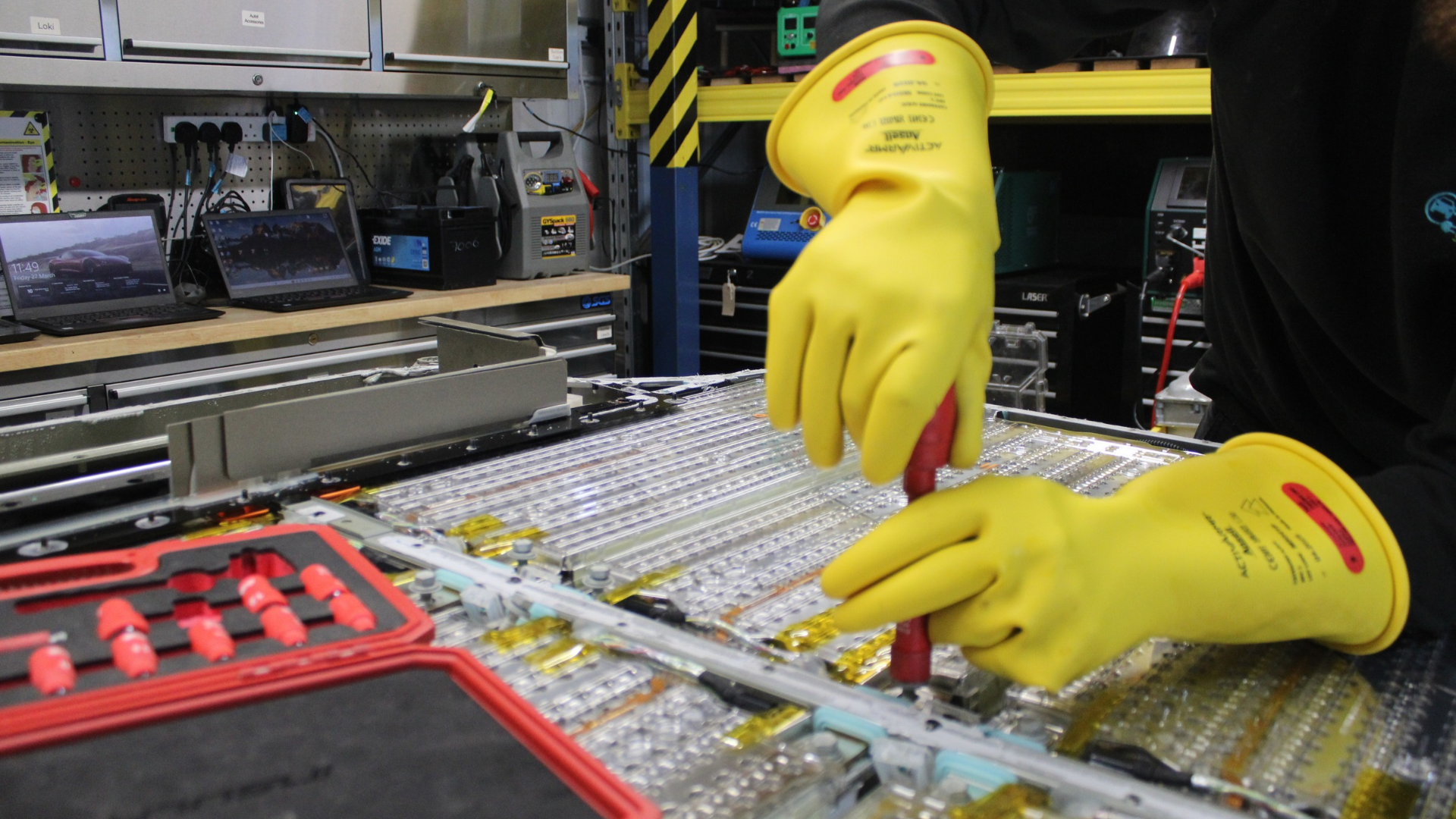
LKQ Electriq applies the same principle to EV batteries, repairing at module level rather than replacing the pack.
Where a part is coded to the vehicle, that often avoids programming work as well as the cost of a new unit. As vehicles get more electronically complex, component repair moves from niche to mainstream.
What matters is repairers having the choice and access to all parts options: remanufactured and reused OE, repaired components, aftermarket, and new OE. That way, they can balance repair economics with the best solution for the customer.
What the EV battery question tells us
The economics of electric vehicle battery repair crystallize this argument further.
When a specialist team diagnoses a premature battery failure, nine times out of ten there is a viable repair pathway, even if that reality isn’t yet widely understood.
The difference between following that repair route and defaulting to full battery replacement is typically the difference between a job costing around £7,000 and one costing £20,000 or more.
For the customer, that gap is the difference between a viable repair and an early write-off.
And the supply chain implications go further still. A single recovered battery pack can provide the components needed to repair up to 16 vehicles with single-module failures. That is a fundamentally different approach to the lifecycle of a vehicle.
This is also why the integration between our salvage, dismantling and specialist repair operations like LKQ Electriq matters operationally.
We’re creating a closed loop in which demand for specific EV components directs acquisition decisions at auction, and recovered material is directed to where it holds highest value. Neither side works as efficiently without the other.
The confidence gap
None of this scales-up without technician confidence. And that is where there is still ground to make up.
A technician who doesn’t trust a reused or remanufactured part won’t specify it, regardless of the cost or environmental case.
That’s a rational response to uncertainty. The question is whether the industry can remove that uncertainty through consistent quality standards, VIN-level traceability, warranty parity and accurate parts data.
Training is the other half of that. It's easy to treat skills and parts strategy as separate conversations, but they're the same one.
Our investment in LKQ Academy is increasingly about equipping technicians to assess and specify alternative parts options as confidently as they'd fit a new OE part, alongside the diagnostics, EV and ADAS content people expect.
A technician who understands how a remanufactured unit is tested is a technician who'll use one.
When a reused OE part can be specified with the same confidence as a new one, behaviors will change and the economics of repair improve across the whole system.
The skill required to choose well between new OEM, trusted aftermarket, remanufactured, reused OE and specialist component repair is itself an increasingly important part of what a technician brings to the job.
The policy dimension
None of this sits outside the regulatory context. The EU’s revised End-of-Life Vehicle regulation and right-to-repair legislation moving through Brussels are both pushing in the direction of greater circular economy ambition for the aftermarket.
France is currently one of the only European markets with a legal requirement to offer customers the choice of circular economy parts. That model is worth watching as a template for what pan-European policy could look like.
The MVBER consultation, now entering its next phase, also matters here. Access to VIN-level parts data and diagnostic protocols is a prerequisite for making alternative repair pathways viable.
Restricting that access drives up costs and pushes vehicles towards the scrap heap earlier than necessary. That is a point we will be pressing hard as the process advances.
The direction of travel
I’ve written before about the mixed fleet of the future. EVs, hybrids, ICE vehicles and an increasing number of Chinese-manufactured cars, all needing to be serviced by an industry that is simultaneously reskilling and retooling.
The repair model that serves that fleet well will not be built around a single default parts option. It will be one that can draw on the full range and make the right call for the right job.
Getting there requires professionalized supply chains, continued investment in training, and data access that enables rather than obstructs repair. These are the conditions that make sustainable repair practical rather than aspirational.
The economic case is already there. The infrastructure is developing. The policy direction is broadly aligned.
As ever, I’d be interested to hear whether this reflects what you’re seeing on the ground. Where are the most promising shifts towards repair and reuse? And where do the structural barriers remain? Comments are open.